The Seven Deadly Sins List: Meanings and What Each One Looks Like
The seven deadly sins are pride, greed, lust, envy, gluttony, wrath, and sloth. Explore their meanings, everyday examples, and history.
What are the seven deadly sins? Names and meanings
The seven deadly sins list is pride, greed, lust, envy, gluttony, wrath, and sloth. In Christian moral tradition, they are also called capital vices: patterns understood to give rise to other sins. Greed is also called avarice; sloth is associated with acedia. The names and groupings have varied across writers. See the Catholic Catechism, paragraph 1866.
The seven deadly sins list at a glance
| Sin | Core meaning | An illustrative everyday cue |
|---|---|---|
| Pride | Placing yourself above others | Credit becomes more important than truth |
| Greed | An excessive desire to acquire or keep possessions | Acquiring more becomes the goal |
| Lust | Sexual desire pursued without proper regard | Desire pushes aside responsibility |
| Envy | Resenting another person's good fortune | Their success feels like your loss |
| Gluttony | Excess in eating and drinking | Consumption continues beyond a reasonable limit |
| Wrath | Anger that becomes excessive or destructive | Retaliation outweighs a fair response |
| Sloth | Neglect or aversion towards a good one ought to pursue | Avoidance displaces care and commitment |
This is a guide to the names and their background. For your own seven scores, the 7 deadly sins test uses 14 everyday statements and a modern entertainment adaptation of the labels. A result is a prompt for conversation, not a religious judgment or a psychological diagnosis.
The seven deadly sins, explained through ordinary scenes
The definitions below follow a historical moral vocabulary. The everyday scenes are our own examples, and the seven images belong to SEVEN / SELF's original The Alibi illustration series. Reading an image can open up a question about a habit; it cannot prove anything about the character of the person looking at it.
There is no universal ranking built into the order shown here. The list is a set of categories, and several can overlap in one situation. Keeping the distinctions clear is more useful than trying to choose a single “worst” label.

Pride
Pride is an excessive attachment to your own excellence or importance. In the traditional moral sense, it places the self above its proper limits and makes correction difficult. Aquinas discusses this as an unreasonable desire for excellence. This differs from feeling pleased after doing something difficult: satisfaction in good work does not require anyone else to be diminished.
In everyday life. Imagine a team presentation that went well. You contributed a useful idea, but the discussion afterwards turns into a campaign to prove that the whole success belonged to you. Another example is rejecting helpful feedback because accepting it would mean admitting that someone else saw what you missed. These are illustrative scenes, not a checklist for judging a person. The question is whether protecting your image has started to matter more than the shared work.
In art. Our original illustration, The Encore, places a mirror among peacock feathers. Read it as a small stage built for one viewer: yourself. The feathers turn being noticed into spectacle; the mirror sends attention back to its owner. This is SEVEN / SELF's modern visual interpretation, rather than an illustration copied from a historical religious manuscript.
When you ask for recognition, are you asking for fairness or for the room to revolve around you?
Historical definition: Aquinas, Summa Theologiae, II–II, question 162.
Which pattern sounds familiar? Take the 14-statement 7 deadly sins test.

Greed
Greed, also called avarice, is an excessive desire to acquire or keep wealth and possessions. Aquinas treats it as a failure to keep material goods in a reasonable relationship with human needs. Saving for rent, enjoying a useful purchase, or seeking financial stability does not by itself make an action greedy.
In everyday life. A modern example would be claiming more than your fair share of a shared payment even though the extra money matters much more to the people who did the work. Another might be collecting upgrades for the feeling of owning them while never using what you already have. The useful distinction from gluttony is acquisition versus consumption: greed wants to possess the next thing, while gluttony keeps consuming what is already available.
In art. In The Lockbox, our toad sits on a closed wooden coffer. The composition makes guarding the object more prominent than enjoying anything inside it. That is our chosen metaphor for a possession becoming an end in itself. The toad is part of this site's illustration system; it is not presented here as the single universal symbol for avarice.
If nobody could see what you owned, which of your next purchases would still matter?
Historical definition: Aquinas, Summa Theologiae, II–II, question 118.
Which pattern sounds familiar? You can take the test.

Lust
In traditional Christian moral writing, lust concerns disordered sexual desire or pleasure. Aquinas discusses it specifically in relation to sexual matters. It should not be casually redefined as every strong ambition or every enjoyable experience. Attraction, a feeling that arises, and a deliberate action are also different things.
In everyday life. For an everyday illustration, consider someone pursuing an exciting flirtation while concealing an existing commitment, or treating another person mainly as a source of gratification. The point of the example is the relationship between desire and responsibility. Our entertainment quiz uses a broader adaptation about intensity and impulsive attraction; that scoring label is not a translation of the full theological definition.
In art. The Almost shows two hands reaching towards one another between dark red curtains, with a ribbon drawing a line through the space. In our reading of the scene, the unfinished touch holds the viewer at the moment before a choice. Its appeal comes from anticipation. It illustrates a tension between wanting and deciding, without claiming to reveal anyone's private life.
What promise or boundary would you want to remember before following the spark?
Historical definition: Aquinas, Summa Theologiae, II–II, question 153.
Which pattern sounds familiar? You can find your sin.

Envy
Envy is distress or resentment at another person's good, experienced as though it reduced your own standing. Aquinas distinguishes this from merely noticing that someone has something you want. Admiring another person's ability and deciding to practise can move you towards a good of your own; envy makes their possession of it the problem.
In everyday life. Suppose a friend receives a promotion. You would like a better job too, but instead of asking what you can learn, you hope their new role will go badly. In a smaller scene, you dismiss a colleague's achievement to make the comparison sting less. These examples turn on resentment, rather than on the ordinary disappointment of wanting something you have not yet reached.
In art. Our two hounds watch a single bone on a brass stand in The Side-Eye. The shared focus makes comparison visible: each animal's attention is tied to what the other might receive. The picture is an invitation to notice a competitive frame of mind. It does not imply that every friendship, ambition, or feeling of unfairness belongs under envy.
Could you want the same opportunity while still hoping the other person does well?
Historical definition: Aquinas, Summa Theologiae, II–II, question 36.
Which pattern sounds familiar? Try the 14-question quiz.
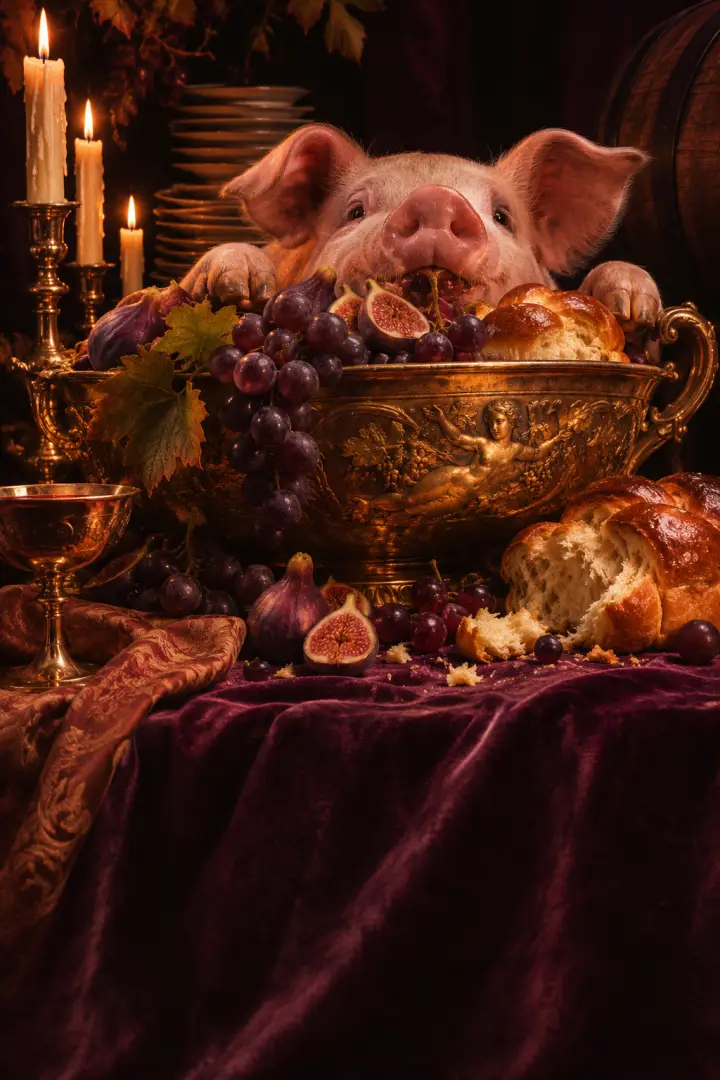
Gluttony
Gluttony traditionally concerns an unreasonable appetite for food and drink. Aquinas discusses the ordering of appetite rather than making the word a judgment about someone's appearance. Body size, enjoying a meal, and needing nourishment do not establish a moral failing. The concept concerns how appetite is pursued.
In everyday life. A simple fictional scene is carrying on an expensive feast while ignoring the needs and responsibilities around it. In a modern metaphor, the same shape appears when one more episode or one more scroll repeatedly crowds out a plan you meant to keep. Those screen habits are analogies used by this site; they are broader than the historical definition. A habit alone also cannot tell us why a person is struggling.
In art. The Second Helping places a pig behind a bowl that already overflows. The visual joke is the presence of abundance before the next helping has even arrived. We use the scene to ask where enjoyment ends and automatic continuation begins. This original artwork illustrates a pattern of excess, rather than assigning a moral meaning to a human body or a medical condition.
What would enough look like if you decided on the stopping point before you began?
Historical definition: Aquinas, Summa Theologiae, II–II, question 148.
Which pattern sounds familiar? Take the 14-statement 7 deadly sins test.

Wrath
Wrath is anger pursued in a disordered way: excessive retaliation, cruelty, or a wish to injure. It is not identical to every experience of anger. Aquinas explicitly considers circumstances in which anger can be reasonable. Feeling that something is wrong and choosing a proportionate response are different from letting revenge set the terms.
In everyday life. Imagine a disagreement that begins with a small mistake and ends with a message written to humiliate someone publicly. Or think of keeping an argument alive after the practical issue has been solved because winning now feels more important than repair. In both scenes the response has moved beyond the original problem. Describing a moment this way does not make anger itself forbidden or diagnose a temperament.
In art. The Line places a bear beside an overturned dining table. In our interpretation, the displaced furniture shows how a confrontation changes the whole room, affecting people beyond the immediate disagreement. The bear can suggest force and a defended boundary; the table asks what that force has cost. This is an interpretation of our contemporary illustration, not a fixed historical code.
What outcome would solve the problem without making the other person suffer for it?
Historical definition: Aquinas, Summa Theologiae, II–II, question 158.
Which pattern sounds familiar? Take the 14-statement 7 deadly sins test.

Sloth
Sloth is often reduced to laziness, but its theological history includes acedia. Aquinas describes sorrow in relation to spiritual good, a more specific concern than simply having a quiet afternoon. The traditional category is about a failure of engagement with a good one ought to pursue. It is not a medical explanation for low energy.
In everyday life. An illustrative modern scene is repeatedly abandoning a responsibility you value, despite having a reasonable opportunity to begin, because avoidance is easier in the moment. Still, two people can leave the same message unanswered for very different reasons. Rest, exhaustion, illness, disability, uncertainty, and lack of support should not be collapsed into a moral label. Our quiz asks about delay; it cannot determine its cause.
In art. In The Late Checkout, a grey donkey sleeps on a packed suitcase. Our illustration turns being ready to leave into an extended pause: the bag is packed, yet the journey has not started. Its gentle humour fits this site's entertainment setting. It is a metaphor for postponement, rather than a claim that sleep, recovery, or needing help is itself a sin.
What is one small, realistic act of care you can choose when you have the capacity?
Historical definition: Aquinas, Summa Theologiae, II–II, question 35.
Which pattern sounds familiar? Take the 14-statement 7 deadly sins test.
Where the seven names come from
The familiar list took shape through a long conversation about moral and spiritual life. In the fourth century, Evagrius Ponticus described eight tempting thoughts in Praktikos, chapter 6, including sadness and vainglory. Read the text in Luke Dysinger's translation.
In the sixth century, Gregory the Great described seven principal vices in Moralia in Job, book 31, chapter 45, section 87. His account treats pride as their root and includes vainglory and melancholy, so it should not be presented as an exact copy of today's list. Read Gregory's account. Aquinas later explained how a capital vice can lead to other vices in Summa Theologiae, I–II, question 84.
The seven deadly sins in literature
Dante's Purgatorio gives the categories a memorable literary structure: the seven terraces concern pride, envy, wrath, sloth, avarice, gluttony, and lust. That is a literary arrangement with its own order, rather than a personality-scoring system. The Princeton Dante Project explains the terraces and links to the poem.
Our illustrations offer a contemporary visual companion to the names. Their animals, objects, captions, and situations should be read as this site's artistic choices, not as a definitive catalogue of symbols across all periods of art history.
Questions about the seven deadly sins
Mortal vs venial sin: are the seven deadly sins always mortal?
No. The categories describe different things. Capital vices are understood as sources of other sins. In Catholic teaching, mortal sin requires grave matter, full knowledge, and deliberate consent together. Venial sin involves lesser matter, or grave matter without full knowledge or complete consent. Naming a vice does not establish those conditions in a particular person's life.
Are the seven deadly sins in the Bible?
The familiar seven-item list is a later Christian classification, rather than a single list in Scripture. Proverbs 6:16–19 names seven things the Lord hates, but its items differ from the later capital vices.
Where do the seven deadly sins come from?
The list developed over time. Evagrius Ponticus described eight tempting thoughts in Praktikos 6. Gregory the Great later described seven principal vices in Moralia in Job 31.45.87, treating pride as their root; his list differed from today's familiar seven. Medieval writers continued to discuss and organise the categories. Aquinas explains the idea of a capital vice in Summa Theologiae I–II, question 84.
Recognise a familiar pattern?
Fourteen everyday statements. All seven scores. About three minutes, with no account.
7 deadly sins testAlready have scores? The results guide explains how to read them together.